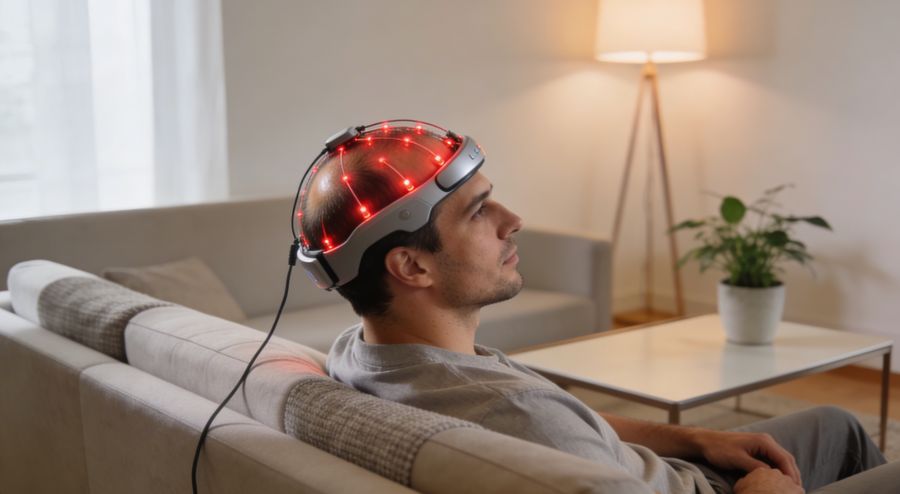
Low-Level Laser Therapy (LLLT) has quietly moved from being a curious gadget on late‑night adverts to a serious, clinic‑backed option for people with thinning hair in Ireland and the UK. Used properly, it can help stabilise hair loss and improve hair quality without injections or surgery, which makes it particularly attractive to men and women who want to act early but are not yet ready for a transplant.
This detailed review explains what LLLT actually is, how it works on the scalp, who is most likely to benefit, how to use it in real life, and how it fits into a broader hair‑restoration plan rather than replacing everything else.
What LLLT for hair loss actually is
LLLT (Low‑Level Laser Therapy) – sometimes called “red light therapy” or “cold laser” – uses low‑energy light in the red or near‑infrared spectrum to stimulate hair follicles. The devices are usually:
-
Rigid helmets or caps
-
Flexible caps worn like a hat
-
Headbands targeting the front of the scalp
-
In older systems, handheld combs or brushes with diodes
Unlike surgical lasers, LLLT does not heat or burn the skin. The power is low enough that you don’t feel pain or heat during a normal session. The aim is biological stimulation rather than destruction.
Most consumer and clinic devices designed for hair loss use wavelengths around 630–680 nm (visible red) and sometimes slightly higher. Sessions are typically 10–30 minutes, several times per week, over many months.
How LLLT is thought to work on hair follicles
Hair follicles are small but metabolically active structures. They constantly cycle between growth, rest and shedding phases. LLLT targets these follicles at a cellular level.
Current understanding (based on lab and clinical data) suggests several mechanisms:
-
Photobiomodulation of mitochondria
The red light is absorbed by components within the mitochondria, particularly cytochrome c oxidase. This can increase production of ATP, the cell’s “energy currency”, giving follicle cells more energy to perform and repair. -
Improved microcirculation
LLLT may promote better blood flow in the scalp’s micro‑vasculature, bringing more oxygen and nutrients to the root of the hair, which is vital in areas prone to miniaturisation. -
Modulation of inflammation and oxidative stress
Low‑level light can influence inflammatory mediators and reactive oxygen species, both of which are involved in the miniaturisation process in androgenetic alopecia. -
Effects on the hair cycle
By improving cellular energy and the local environment, LLLT appears to prolong the growth phase (anagen) and shorten the resting phase (telogen), leading to more hairs growing at any given time.
In practical terms, this can translate into:
-
Reduced daily shedding
-
Thicker individual hair shafts
-
Better coverage in areas where hair has thinned but not completely disappeared
It is important to stress: LLLT cannot resurrect dead follicles. In shiny, fully bald areas present for years, it will not create new hair from nothing.
Who is a good candidate for LLLT?
LLLT is not a magic bullet, but it can be a very useful tool for particular situations.
You are more likely to benefit if:
-
You have early to moderate androgenetic alopecia (male or female pattern hair loss)
-
There is still plenty of hair present, even if it is thinner and miniaturised
-
Your main complaints are increased shedding and reduced volume rather than totally bare patches
-
You prefer non‑invasive options, at least initially
-
You are willing to commit to a regular routine over many months
LLLT can be helpful for:
-
Men with Norwood stage 2–4 (receding hairline, thinning crown but still visible coverage)
-
Women with Ludwig or diffuse thinning patterns, especially along the parting
-
Patients who have had a hair transplant and want to support both transplanted and native hair
-
People who cannot tolerate or do not wish to use certain medications but still want to do something proactive
Candidates who are less likely to see big benefits include:
-
Those with very advanced baldness and almost no hair in the target area
-
People expecting instant, dramatic regrowth rather than gradual improvement
-
Anyone unable to maintain regular usage for more than a few weeks
Types of LLLT devices: clinic vs home use
In Ireland and the UK, patients will typically encounter two broad categories of device.
Clinic‑based systems
Some hair clinics use professional‑grade machines, often in the form of a large hood or dome that sits over your head while you relax in a chair. Sessions are done on‑site, usually several times per week at the beginning.
Benefits:
-
No need to purchase your own device
-
Treatment carried out under staff supervision
-
Easy integration with in‑clinic reviews and other therapies
Drawbacks:
-
You must travel to the clinic regularly
-
Scheduling can be harder if you have a busy job or commute
-
Over time, session fees can become comparable to buying your own cap
At‑home caps and helmets
The biggest growth has been in wearable caps and helmets with built‑in diodes. You wear them for a set time, often 10–20 minutes, a few times per week.
Benefits:
-
Convenience – you can use them at home while reading, watching TV or working
-
Privacy – useful if you prefer not to be seen attending a hair clinic
-
Fixed one‑time cost (with some devices offering warranties)
Drawbacks:
-
Upfront investment can be significant
-
The burden of consistency falls entirely on you
-
Quality and specifications vary widely between brands
Regardless of the format, the underlying principle is the same: regular exposure of thinning areas to the correct wavelength and dose of light over many months.
What a realistic LLLT routine looks like
One of the biggest predictors of success with LLLT is consistency. The treatment is gentle, but that also means the effects accumulate slowly.
A typical routine might look like:
-
3 sessions per week
-
15–20 minutes per session
-
For a minimum of 6 months before judging results
-
Ongoing use for maintenance if benefits are seen
Many people schedule sessions around existing routines:
-
Evenings while watching TV
-
Early morning before work
-
During a regular home‑gym or stretching session
Because sessions are hands‑free, it is relatively easy to build them into daily life, but discipline is still required. Using the device for two weeks and then letting it gather dust will not yield much.
When will you see results from LLLT?
It’s important to understand the timeline so you do not abandon the treatment prematurely.
Typical expectations:
-
First 1–2 months
Minimal visible change. Some people may even notice a slight temporary increase in shedding as hairs synchronise in the cycle – this can be alarming but is usually transient. -
Around 3–4 months
Shedding often settles. Some users report hair feeling stronger, with less hair on the pillow or in the shower. -
Around 6 months
This is usually the earliest sensible point for a before/after comparison. Improvements often include better coverage in previously “see‑through” areas, especially under bright light. -
9–12 months and beyond
Full benefit becomes clearer. At this stage you decide whether to continue indefinitely, step down frequency, or integrate other interventions.
It’s very similar to physical training: one gym session never changed a body, but a consistent routine over months does.
Advantages of LLLT for hair loss
LLLT occupies a useful niche between “doing nothing” and jumping straight to injections or surgery.
Key strengths include:
-
Non‑invasive and painless
No needles, no incisions, no anaesthetic. This is appealing for people who dislike medical procedures. -
Minimal downtime
You can use a cap before work and go straight to the office; there is no visible mark afterwards. -
Very good safety profile
When used correctly, side‑effects are usually limited to occasional mild scalp warmth, tightness or short‑lived irritation. -
Suitable for long‑term use
There is no fixed maximum “course”. You can continue for years if you find it helpful. -
Compatible with other treatments
LLLT can be combined with medicated lotions, oral treatments, PRP, mesotherapy or hair transplants. Often, it is part of a multi‑modal approach instead of a stand‑alone fix. -
Improves hair quality, not just count
Even without massive new hair numbers, thicker and stronger shafts can make a big cosmetic difference, especially for women with diffuse thinning.
Limitations and drawbacks of LLLT
A balanced review needs to be clear about what LLLT cannot do and where it can disappoint.
-
No miracle regrowth in bald patches
Where follicles are gone, no amount of light can create new ones. LLLT is about supporting existing follicles, not manufacturing them. -
Variable response
Some users see strong benefits; others see modest changes; a minority may see little to no improvement. Genetics, stage of loss and consistency all play a role. -
Time commitment
While individual sessions are short, the need for frequent, long‑term use is a genuine commitment. -
Cost
Quality devices are not cheap. Over years, the cost is usually less than repeated clinic treatments, but the initial outlay can be substantial. -
Risk of false expectations
Aggressive marketing can oversell results, leading to frustration when outcomes are more subtle and gradual.
Understanding these points upfront protects you from both over‑optimism and premature abandonment.
LLLT alongside hair transplants: how they fit together
For many patients in Ireland and the UK, the most powerful way to use LLLT is not as a replacement for a hair transplant, but as a partner to surgery.
Before a transplant
Using LLLT in the months before a procedure can:
-
Improve scalp condition and blood flow
-
Support miniaturised hair in areas that won’t be transplanted immediately
-
Potentially help define which areas are genuinely “dead” versus just weak
This can help the surgeon plan more accurately and may optimise the scalp environment before grafts are placed.
After a transplant
Post‑transplant, LLLT can be introduced when healing allows (according to the surgeon’s protocol) to:
-
Support the recovery process at both donor and recipient sites
-
Enhance comfort by easing low‑grade inflammation
-
Help maintain non‑transplanted hair around the transplanted zones
The main goal is not to make grafts “take” – that depends heavily on surgical quality and care – but to support the broader scalp ecosystem.
Long‑term maintenance
Once your transplant result has matured, LLLT can become part of a long‑term maintenance routine that also includes:
-
Appropriate topical or oral treatments, if suitable
-
Lifestyle measures supporting hair health
-
Periodic check‑ups to monitor further loss
Seeing LLLT as a maintenance tool helps you protect your surgical investment over time.
Using LLLT with other non‑surgical therapies
Because LLLT is gentle and non‑systemic, it combines well with other, more established treatments.
Common combinations include:
-
Topical treatments – applied at different times of day from LLLT sessions
-
Oral medications – addressing systemic hormonal drivers while LLLT works locally
-
Regenerative therapies (like PRP or mesotherapy) – periodically “boosting” the scalp, while LLLT provides steady background support
A multi‑modal plan is often more effective than relying on one single method, particularly once hair loss has clearly established itself.
Practical tips if you’re considering LLLT in Ireland or the UK
If you are thinking about adding LLLT to your routine, a few practical guidelines can help you get the most from it:
-
Get a proper diagnosis first
Make sure your hair loss pattern is properly assessed. Not all thinning is androgenetic; some conditions require different treatment priorities. -
Choose a reputable device or clinic
Pay attention to wavelength, coverage, design and warranty rather than just marketing language. Cheap, poorly designed devices may not deliver meaningful energy to the follicles. -
Set realistic expectations
Aim for stabilisation and improvement, not miraculous regrowth. If your expectations align with reality, you’re less likely to abandon a working treatment too soon. -
Commit to at least 6–12 months
Decide in advance that you will use the device consistently for this period before judging it. Short trials are almost always inconclusive. -
Integrate into routine, not willpower alone
Tie LLLT sessions to existing habits (evening TV, reading, emails) so they happen almost automatically. -
Track progress
Take photos in the same lighting every 2–3 months. Day‑to‑day you may not notice changes; objective comparisons help. -
Review regularly
Revisit your plan with a hair specialist at least yearly to adjust your mix of treatments as your hair and priorities change.
Final thoughts: LLLT as part of a long‑term hair strategy
Low‑Level Laser Therapy for hair loss is neither a gimmick nor a miracle cure. Used correctly, it is a sensible, scientifically grounded way to support existing follicles, slow down visible thinning and improve hair quality over time, with almost no disruption to daily life.
For many people in Ireland and the UK, the most powerful role for LLLT is as a long‑term maintenance tool: starting early, continuing steadily, and sitting alongside other therapies and, where appropriate, hair transplantation. When you treat it as one piece of a broader, multi‑year strategy rather than a quick fix, it can become a valuable ally in keeping your hair looking better for longer.
If you tell me your age and whether your main concern is hairline, crown, or general thinning, I can suggest how LLLT could realistically fit into a 2–3 year plan tailored to that pattern.