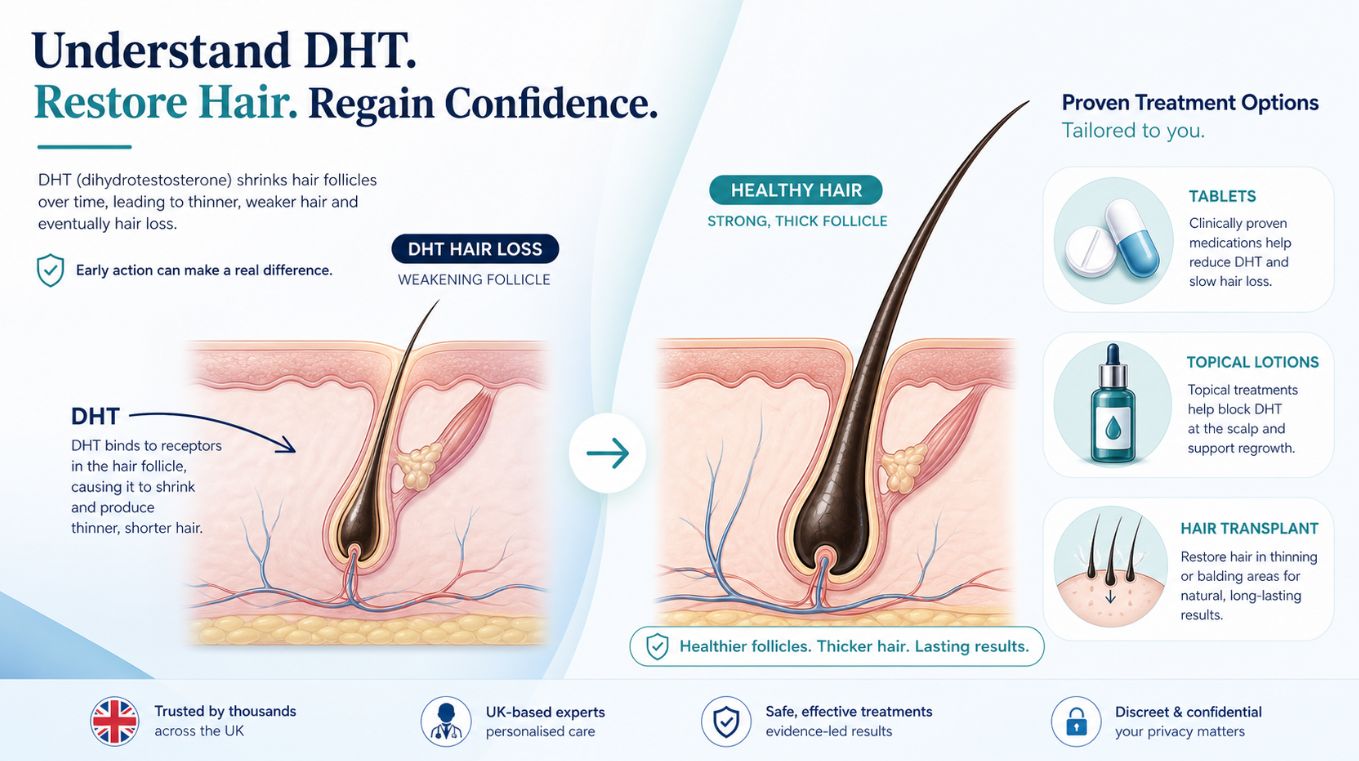
DHT-related hair loss is one of the most common, frustrating, yet manageable forms of alopecia affecting both men and women in the UK. By understanding how this hormone works, you can choose the right mix of medical, surgical, and lifestyle solutions – including hair tourism – to protect and restore your hair for the long term.
What Is DHT and Why Does It Affect Hair?
Dihydrotestosterone (DHT) is a powerful androgen derived from testosterone through the action of an enzyme called 5‑alpha reductase. It plays an important role in male development, but in genetically susceptible people it also becomes the key driver behind androgenetic alopecia, better known as pattern hair loss.
Hair grows in cycles: a long growth phase (anagen), a brief transition (catagen), and a resting and shedding phase (telogen). In people sensitive to DHT, the hormone binds to receptors in certain follicles (typically along the hairline and crown) and gradually disrupts this cycle. Over time, DHT shortens the growth phase and prolongs resting and shedding, so hairs grow for less time and fall out sooner than they are replaced.
This process is called follicular miniaturisation:
-
Follicles slowly shrink under prolonged DHT exposure.
-
Thick, pigmented “terminal” hairs become finer, shorter and lighter.
-
Eventually, follicles may stop producing visible hair altogether.
Once a follicle is fully inactive, no topical lotion or supplement can bring it back – at that point, only surgical restoration can replace what has been lost.
Who Is at Risk of DHT Hair Loss?
DHT hair loss is strongly linked to genetics and family history. Variations in the androgen receptor gene make some people’s follicles more likely to bind DHT, which explains why pattern hair loss “runs in the family” even when testosterone levels are normal.
Risk factors include:
-
Family history of early hair loss on either side.
-
Male sex (men produce more DHT), but women can also be affected.
-
Ageing, with symptoms often starting in the 20s–40s and progressing over time.
-
Hormonal shifts, such as menopause or conditions like PCOS in women, which can alter androgen balance.
Lifestyle and health factors (stress, poor diet, illness) do not cause DHT sensitivity, but they can worsen shedding and make pattern loss more obvious.
Signs and Symptoms of DHT Hair Loss
Although DHT hair loss can look slightly different from person to person, several patterns are typical.
Common signs include:
-
Receding hairline at the temples, forming an “M” shape.
-
Thinning at the crown that slowly widens.
-
A widening parting and diffuse thinning in women.
-
Finer, fluffy hairs replacing thicker strands in affected areas.
The process is usually gradual and painless, which is why many people delay seeking help until the change is obvious in photos or under bright light. Early recognition is important because the earlier you intervene, the more follicles are still salvageable.
Non-Surgical Medical Solutions: Tackling DHT and Supporting Follicles
For UK patients, the first line of defence against DHT hair loss is usually medical treatment. These options aim either to reduce DHT’s impact or to support follicles so they grow thicker, healthier hair.
DHT-Blocking Medicines
The most established DHT‑targeted treatments are prescription medications known as 5‑alpha reductase inhibitors.
Finasteride
Finasteride reduces the activity of one form of 5‑alpha reductase, lowering DHT levels in the scalp and helping to slow or stabilise hair loss.
-
Taken orally, typically once a day.
-
Clinically shown to reduce scalp DHT and slow pattern hair loss in many men.
-
Widely used as a long-term maintenance treatment.
Dutasteride
Dutasteride blocks two types of 5‑alpha reductase and can be more potent than finasteride.
-
May be more effective in some cases, but also more powerful overall.
-
Use for hair loss is more specialist and often off‑label in many countries, so it requires careful medical supervision.
Both medications address the root hormonal pathway rather than simply masking symptoms, but they must be continued to maintain benefits.
Growth-Stimulating Treatments
Not all treatments act directly on DHT. Some work by improving blood flow, extending the growth phase, or enhancing follicle health.
Minoxidil
Minoxidil is a topical treatment applied to the scalp that encourages follicles to stay in the growth phase longer.
-
Available as foam or solution.
-
Can increase thickness and density in areas where follicles are still active.
-
Often combined with DHT‑blockers for a more comprehensive approach.
Low-Level Laser Therapy (LLLT)
LLLT, sometimes called red light therapy, uses specific wavelengths of light to stimulate follicle activity and improve circulation.
-
Delivered via in‑clinic devices or at‑home laser caps and combs.
-
Studies have shown increases in hair density in androgenetic alopecia.
-
Works best as part of a wider treatment plan and requires consistent use over months.
Platelet-Rich Plasma (PRP)
PRP involves processing a small sample of your blood to concentrate platelets and injecting this into the scalp.
-
Growth factors in platelets act like “fertiliser” for hair, helping follicles produce stronger strands.
-
Typically done as a series of sessions spaced weeks apart.
-
Often combined with other therapies for improved outcomes.
These non-surgical approaches are especially useful in early to moderate stages, when many follicles are weakened but not yet irreversibly damaged by DHT.
Non-Medical and Cosmetic Options
Not everyone wants or needs prescription medication. Some people prefer less medical solutions or use them alongside clinical treatments.
Cosmetic Thickening and Camouflage
Camouflage solutions do not affect DHT but can make hair look fuller and disguise thinning areas.
-
Volumising shampoos and styling products that increase strand diameter.
-
Keratin fibres that cling to hair and scalp to reduce contrast.
-
Colour techniques that minimise the visibility of scalp through hair.
These methods are purely cosmetic but can make a significant difference in day‑to‑day confidence.
Scalp Micropigmentation (SMP)
SMP uses tiny pigment deposits to replicate the appearance of hair follicles on the scalp.
-
Can create the impression of a close‑shaved full head of hair.
-
Can also be used under existing hair to reduce the look of contrast.
-
Requires specialist skill and periodic touch‑ups.
SMP is often chosen by men with advanced DHT hair loss who prefer a low‑maintenance look rather than ongoing medications.
Surgical Solutions: When DHT Has Done Its Damage
Once DHT has miniaturised follicles beyond recovery, even the best medical regimen cannot bring them back. At this stage, surgical hair restoration – particularly hair transplantation – is the only way to permanently replace lost hair in those areas.
The Principle Behind Hair Transplants
Some follicles, typically at the back and sides of the scalp, are genetically resistant to DHT. A hair transplant redistributes these “safe” follicles into areas where DHT has caused thinning or baldness.
Key points:
-
DHT‑resistant grafts retain their resistance after being moved, so they continue growing long term.
-
Transplanted hair follows your normal growth cycle and can be washed, cut, and styled like the rest of your hair.
Main Techniques: FUE and FUT
Follicular Unit Extraction (FUE)
-
Individual follicular units are harvested with tiny punches and implanted into thinning areas.
-
Leaves minimal dot‑like scarring, allowing short hairstyles.
-
Very popular in modern hair tourism centres.
Follicular Unit Transplantation (FUT)
-
A strip of scalp is removed from the donor area, dissected into grafts, and transplanted.
-
Leaves a linear scar, usually hidden by surrounding hair.
-
Can be efficient for high graft numbers in suitable candidates.
Both methods require careful planning of hairline design, density, and graft distribution to achieve a natural look that holds up as DHT‑related loss continues in surrounding hair.
Hair Tourism for DHT Hair Loss
Because hair transplantation is a specialist and often expensive procedure, many UK patients consider travelling abroad to established hair tourism destinations.
Popular locations include:
-
Turkey, where clinics frequently market DHT‑related hair loss solutions with high‑volume FUE procedures.
-
Central and Eastern Europe (such as Hungary), offering EU‑regulated standards and package pricing appealing to UK travellers.
Advantages:
-
Lower overall cost compared to many UK clinics, often including accommodation and transfers.
-
Surgeons and teams experienced in managing extensive DHT hair loss patterns.
-
Short waiting times and all‑inclusive treatment packages.
Considerations:
-
Wide variation in quality and level of surgeon involvement.
-
Limited in‑person aftercare when you return home.
-
Need to verify credentials, patient results, and safety standards before booking.
Preventing and Slowing DHT Hair Loss
You cannot change your genetics, but you can significantly influence how quickly DHT hair loss progresses and how visible it becomes.
Targeting DHT Early
Intervening before widespread miniaturisation makes the biggest difference.
-
Start DHT‑blocking treatment (such as finasteride) at the first confirmed signs of pattern loss, under medical guidance.
-
Combine with minoxidil to support follicles through a stronger growth phase.
-
Consider supportive therapies like LLLT or PRP if your budget allows and you want to maximise results.
The goal is to preserve as much native hair as possible so that, if surgery is needed later, you need fewer grafts and enjoy better coverage.
Lifestyle and Scalp Health
While lifestyle cannot neutralise DHT alone, it can support treatment and keep remaining hair in the best possible condition.
Helpful steps:
-
Eat a balanced diet with enough protein, iron, vitamin D, and zinc, as deficiencies can exacerbate shedding.
-
Manage chronic stress, which can trigger shedding episodes that worsen the appearance of DHT‑driven thinning.
-
Avoid overly tight hairstyles, harsh chemical treatments, and frequent high‑heat styling that can physically damage fragile, miniaturised hairs.
Some people also try natural DHT‑blocking ingredients like saw palmetto or rosemary, but scientific support is currently weaker than for established medications.
Short-Term vs Lasting Solutions
Different DHT hair loss treatments offer different levels of durability and impact. Understanding this helps you build a realistic, long‑term plan.
The most successful strategies usually combine several of these rather than relying on a single option.
Creating a Long-Term Plan for DHT Hair Loss
DHT hair loss is chronic and progressive, so it helps to think like you would about any long‑term health condition.
A structured approach might look like this:
-
Step 1: Confirm the diagnosis
See a GP or hair specialist to confirm that DHT‑driven pattern loss is the main cause and to rule out other conditions such as thyroid disease or alopecia areata. -
Step 2: Stabilise with medical therapy
Begin evidence‑based treatments such as finasteride and minoxidil (if appropriate), and give them several months to take effect. -
Step 3: Enhance with adjuncts
Consider LLLT, PRP, or targeted scalp care to maximise the health and thickness of remaining hair. -
Step 4: Assess need for surgery
If certain areas are now bare or extremely thin, consult experienced transplant surgeons in the UK and reputable hair tourism destinations to discuss realistic expectations, graft numbers, and timing. -
Step 5: Maintain for life
Continue a sustainable regimen of DHT‑blocking and follicle support to protect both transplanted and native hair as you age.
Moving Forward with Confidence
DHT hair loss can feel relentless, but it is one of the best‑understood forms of alopecia, with multiple proven ways to slow, disguise and reverse its effects. Whether you choose medication, advanced non‑surgical therapies, hair transplant surgery in the UK or abroad, or a combination of all three, the key is to act early, set realistic expectations, and work with trusted specialists.