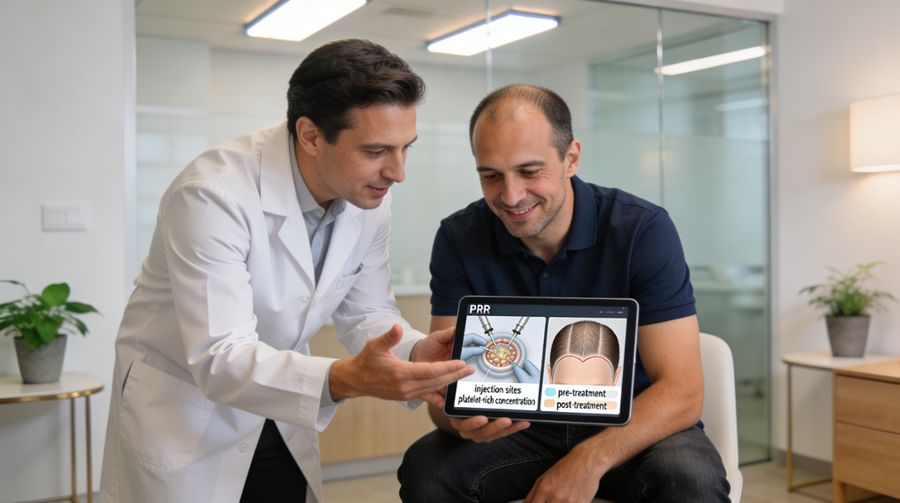
Platelet-rich plasma (PRP) and hair transplant surgery are often presented as two very different paths for treating hair loss – one non-surgical and regenerative, the other surgical and reconstructive. In reality, they are best understood as complementary tools that, when used intelligently together, can significantly improve both short‑ and long‑term outcomes for men and women dealing with thinning hair in Ireland, the UK and beyond.
This in‑depth review looks at how PRP works, what hair transplants can realistically achieve, and how the two can be combined into a coherent treatment plan rather than seen as competing options.
Understanding PRP: what it really is (and isn’t)
PRP (platelet‑rich plasma) is a concentration of platelets taken from your own blood. Platelets are rich in growth factors – signalling proteins that support tissue repair, blood vessel formation and cellular activity. In the context of hair, the idea is straightforward: bring a high dose of these natural growth factors directly to weakened hair follicles to help them function better.
How PRP is prepared and used
A typical PRP session follows a simple pattern:
-
A small sample of blood is taken from your arm.
-
This sample is spun in a centrifuge to separate its components.
-
The platelet‑rich fraction is drawn up into syringes.
-
PRP is injected in small amounts across areas of thinning on the scalp.
The injections are placed in the superficial layer of the skin where the hair follicles sit. Mild local anaesthetic or a numbing cream is often used to keep the procedure comfortable.
Because the product comes from your own blood, PRP is classed as “autologous”. That means no synthetic drugs are added and the risk of allergy or rejection is extremely low. Most people tolerate it very well beyond some short‑lived redness or tenderness.
What PRP can realistically achieve
PRP is a stimulatory treatment, not a replacement for lost follicles. It tends to work best when:
-
There is visible thinning and miniaturisation, but still a decent number of hair follicles present.
-
The goal is to slow down ongoing loss and improve hair quality.
-
You want to support medicated treatments (like topical or oral therapies) rather than replace them.
When it responds well, PRP can lead to:
-
Reduced daily shedding.
-
Thicker‑diameter hairs.
-
Better texture and shine.
-
A visible improvement in coverage in mildly to moderately thinned areas.
It does not recreate hair in shiny bald zones where follicles have been gone for years. In those areas, PRP alone is very unlikely to make a noticeable cosmetic difference.
How many PRP sessions are needed?
PRP is not a one‑off procedure. Most treatment plans are broken into:
-
Induction phase – usually 3–4 sessions spaced about 4–6 weeks apart.
-
Maintenance phase – top‑up sessions every 4–6 months, sometimes twice a year for stable cases.
First changes often appear after several months, not weeks. Anyone considering PRP should go in with a mindset of ongoing maintenance, very similar to dental hygiene or regular gym training.
Hair transplants: what surgery actually does
A hair transplant is a surgical procedure where hair follicles are moved from “permanent” donor zones (typically the back and sides of the scalp) to areas of balding or thinning. Those transplanted follicles are genetically more resistant to male‑ or female‑pattern hair loss and usually keep that resistance in their new home.
The two main methods
In modern practice, two techniques are dominant:
-
FUE (Follicular Unit Extraction)
Individual follicular units (small groups of 1–4 hairs) are removed one by one using tiny punches, then replanted into recipient sites in the thinning area. -
FUT (Follicular Unit Transplantation / strip surgery)
A thin strip of scalp is removed from the donor area, and the strip is dissected into grafts under a microscope. The donor area is closed with sutures.
Both techniques aim to place individual grafts into carefully designed incisions to mimic natural hair direction and density. FUE leaves dot scars in the donor area; FUT leaves a linear scar. A skilled surgeon can achieve excellent cosmetic results with either method – the right choice depends on hair type, donor capacity, long‑term planning and personal preference.
What a transplant can and cannot do
A hair transplant can:
-
Rebuild a receding hairline.
-
Fill in bald patches, like a crown/vertex.
-
Increase coverage in diffuse thinning areas.
-
Create a permanent “frame” for the face when designed well.
It cannot:
-
Stop the underlying process of androgenetic alopecia from progressing in non‑transplanted hair.
-
Replace unlimited hair – the donor supply is finite.
-
Guarantee “teenage” density everywhere. Even excellent work aims for a cosmetic illusion of fullness, not the density you had at 16.
This is where thinking in terms of long‑term strategy – and where PRP can play a role – becomes crucial.
PRP versus hair transplant: choosing the right tool for the right job
It’s tempting to compare PRP and hair transplant surgery as if they are competing treatments, but they serve different purposes.
When PRP alone might be enough (for now)
PRP is often a sensible first step when:
-
You are in the early stages of hair loss with mild thinning.
-
You still have a lot of miniaturised hair, especially at the top and crown.
-
You’re not ready, practically or psychologically, for surgery.
-
You want a low‑risk, low‑downtime intervention to stabilise things.
In these scenarios, a well‑structured PRP plan (often combined with proven medical therapy) can delay the need for surgery and preserve more hair for the long haul.
When a hair transplant becomes more appropriate
Surgical restoration comes into play when:
-
There are clear bald patches or a strongly receded hairline that no longer responds to non‑surgical measures.
-
The loss is advanced enough that improved hair quality alone will not give an acceptable cosmetic result.
-
You want a lasting structural change – for example, a new hairline design rather than just thicker existing hair.
Even then, surgery works best when you think beyond a single operation and consider how to protect non‑transplanted hair over time.
Why combining PRP and hair transplants often gives better outcomes
Rather than thinking “PRP or transplant”, it’s often more useful to ask “how can PRP support my transplant result and my native hair?”.
There are three key time points where PRP is commonly integrated with surgery.
1. PRP before a transplant: preparing the scalp
Using PRP in the months leading up to a transplant can:
-
Improve scalp vascularity and tissue quality.
-
Strengthen miniaturised hairs surrounding the future grafts.
-
Help bring the scalp into the best possible condition before surgery.
For patients with poor scalp health (chronic inflammation, seborrhoeic issues, smoking history), pre‑conditioning with PRP and other supportive measures can be particularly valuable.
2. PRP around the time of surgery: supporting healing
Some clinics offer PRP on the day of surgery or shortly afterwards. The proposed benefits include:
-
Enhanced healing at both donor and recipient sites.
-
Reduced post‑operative inflammation and potentially less shock loss.
-
Better early graft survival in the critical first weeks as blood supply establishes.
Evidence is still evolving, but there is a growing body of clinical experience suggesting PRP can improve early healing and comfort after a transplant.
3. PRP after a transplant: protecting the long‑term result
Once the transplanted hair has grown in (typically 9–12 months after surgery), PRP can be used as a maintenance tool:
-
To support native hair that is still prone to miniaturisation.
-
To keep the overall scalp environment healthy.
-
To prolong the period before any further surgical work might be needed.
In this phase, the goal isn’t to regrow hair in bald zones (the transplant has already done that); it’s to preserve and optimise everything else.
What a combined treatment journey might look like
While every plan must be individual, it helps to visualise a typical pathway that integrates both PRP and transplantation.
Stage 1 – Assessment and stabilisation
-
Detailed medical history and scalp examination.
-
Clarification of your goals and time horizon.
-
Introduction of appropriate medical therapies where indicated.
-
Start of PRP sessions to reduce shedding and improve hair quality.
The focus here is control and stability rather than cosmetic transformation.
Stage 2 – Surgical design and restoration (if needed)
Once your pattern of loss is better understood and somewhat stabilised:
-
Design of a hairline and distribution strategy that suits your age, face and donor capacity.
-
FUE or FUT transplant to address priority zones like the hairline or frontal third.
-
Possible use of PRP in the peri‑operative period to support healing.
This is where visible change occurs, but it’s built on the foundation created earlier.
Stage 3 – Long‑term maintenance
After the initial transplant result has matured:
-
Periodic PRP sessions (for example twice a year) to support native hair.
-
Ongoing medical therapy and lifestyle measures.
-
Consideration of further surgical work only if needed and justified by donor supply.
The aim is to protect your investment, rather than repeatedly chasing new surgery.
Benefits of combining PRP and hair transplants
Using both modalities within a structured plan offers several clear advantages:
-
Better quality of existing hair
PRP can make non‑transplanted hair thicker and healthier, which enhances the overall cosmetic impact of a transplant. -
More natural transitions
Stronger native hair around transplanted zones creates softer, more natural blending between treated and untreated areas. -
Extended lifespan of the result
By maintaining follicles at risk, you may delay visible progression and reduce the need for further surgeries. -
Potentially improved healing and comfort
Some patients report quicker recovery and less prolonged redness when PRP is used appropriately around surgery. -
Psychological benefit
Having both a structural solution (transplant) and an ongoing supportive therapy (PRP) often gives patients a sense of control and reassurance.
Downsides and limitations to keep in mind
A balanced review also has to address the drawbacks.
PRP limitations
-
Variable response – not everyone sees a dramatic improvement; some experience stabilisation only, others little change.
-
Ongoing cost – multiple sessions over several years can become a significant investment.
-
Time commitment – regular appointments or sessions are needed to maintain benefits.
Hair transplant limitations
-
Finite donor supply – you only get one donor area; poor planning or overharvesting can cause problems later.
-
Progressive nature of hair loss – non‑transplanted hair can still thin, which is why prevention and maintenance matter.
-
Surgical risks – while generally safe with an experienced team, complications are possible with any procedure.
Combined approach considerations
-
Financial planning – combining surgery and PRP is more costly than one treatment alone, so it should be budgeted and prioritised carefully.
-
Need for realistic expectations – even with the best combination, no treatment can guarantee a “perfect” head of hair or completely stop ageing.
Practical tips for patients in Ireland and the UK considering both PRP and a transplant
If you are weighing these options, a few practical principles can help you make informed decisions:
-
Start with a thorough diagnosis
Before committing to any procedure, get a proper assessment of your hair loss pattern, donor reserves and potential underlying triggers. -
Think long term, not in quick fixes
Hair restoration is a process measured in years, not weeks. Plan as if you were managing a chronic condition, not just solving a one‑off cosmetic issue. -
Avoid “max grafts at all costs” marketing
A conservative, strategic transplant that leaves donor reserves for the future is often wiser than a single, overly aggressive mega‑session. -
View PRP as support, not magic
PRP is best seen as a supportive therapy that helps your scalp and hair perform at their best, not as a guarantee of regrowth in bald patches. -
Be consistent
Whether it’s PRP, medication, or post‑op care, consistency usually matters more than chasing the latest trend.
Conclusion: PRP and hair transplants work best as partners, not rivals
PRP treatments and hair transplant surgery solve different parts of the hair loss puzzle. PRP optimises and protects what you still have; transplantation redistributes what is permanent to where it is most needed. When they are combined as part of a clear, long‑term plan tailored to your pattern of loss, age and goals, the result is usually more natural, more durable and more satisfying than either approach used in isolation.
If you tell me roughly your age and whether your main concern is hairline, crown, or general thinning, I can sketch a sample 2–3 year plan showing how PRP and a transplant could realistically be sequenced and combined for your situation.